

The World's Least Favorite Word Means Womb Wisdom

Growing up there were certain words that were not only taboo, but completely forbidden. Never mind that my Southern grandmother thought words like darn and shoot were ‘by-words.’ There was another category of slang language that was unmentionable - names you dare not even think of.
The worst? Cunt.
That one made me feel the need to wash my mouth out with soap. To take a shower and scrub with lye and a pumice stone. I was reared to abhor words relating to my own body. And it wasn’t until the last few years that I even examined why to this day girls generally aren’t allowed to reference their own anatomy in anatomically correct language.
But Socrates said the unexamined life is not worth living, so I felt compelled to extend his idea toward our culture’s vocabulary. The end result should not have surprised me.
Cunt is taboo because it has to do with female power.
It’s the same old story; if something has powerful feminine connotations the narrative must change. Precisely like the number 13 and its ancient associations with women. This is the average number of cycles a woman will have in a year, as well as the number of yearly cycles the moon completes. Entire superstitions have been built around ‘Lucky number 13’, going so far that most elevators continue to omit the 13th floor button.
Likewise, most of us have a disgust of certain animals. Are you afraid of snakes? They were an ancient symbol of the feminine. Do you abhor spiders? Arachnids have been linked to women, with their innate ability to weave, for millennia.
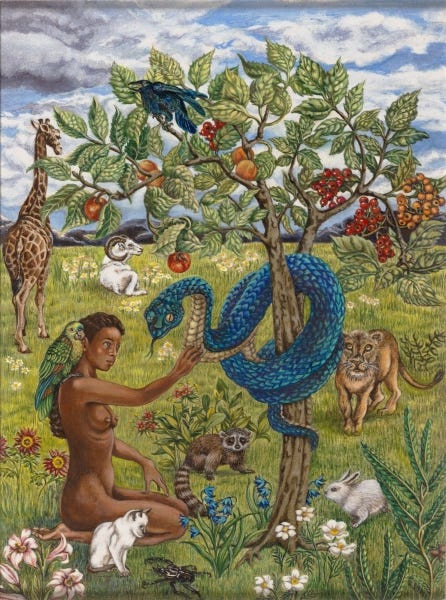
As the oldest word for female genitals in the English language, Cunt was denied entry into the Oxford English Dictionary until the 1970s. The word is powerful, but not because it’s such a smutty curse to throw at someone. It isn’t simply another word for vagina, nor is it ‘dirty’ in any form or fashion. Cunt is powerful because it derives from the word Cunctipotence.
Cunctipotent – (rare – cunctus, all and potens, potent-em, powerful after the classical omnipotens): All-powerful, omnipotent.
Oxford English DictionaryCunctipotent – all powerful (i.e., having cunt-magic)
Barbara Walker (1993, 197)
I was first introduced to this term by my academic advisor for my PhD. I had been wrestling over the verbiage of a particular poem I was workshopping (which I’ve shared at the end of this essay). Initially I included the word Cunt, but removed it after worrying it would be too shocking for people to read. But when this professor read over my draft she immediately asked me about that particular line. In fact, she said I needed to change the word I had used to Cunt. I felt slightly shocked and vindicated at the same time. Of course I needed to use this word to get my point across.
She then let me know that the word has ancient, matriarchal roots, and cunctipotency was ‘womb wisdom’. I was thrilled with this newfound knowledge. It’s a rare professor in academia that can discuss cunts in the most serious, reverent manner.1
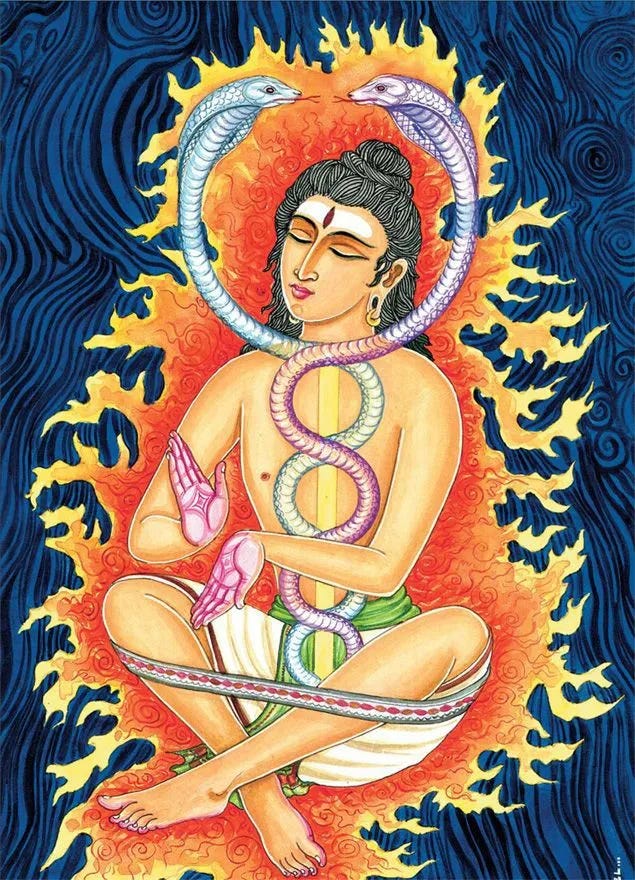
After this I led myself down an interesting rabbit hole. In Encyclopedia of Women’s Myths and Secrets, Barbara Walker traces Cunt to the Asian goddess Cunti and the Indian Buddhist goddess Kundi/Kunda (as in Kundalini yoga). Kundi is seen as the divine Yoni (literally vagina/womb) of the universe. In Hinduism, Kundalini Shakti is represented as a coiled snake, and is a form of divine feminine energy which all genders possess within themselves.
Etymologically, Cunt is also related to words like cunning and ken (knowing, wisdom). One of the best anatomical definitions suggest the word originally meant ‘a little house.’ And while we have many other words that could be used for the female sexual organs, none of them have become such a curse to throw at someone.
Several scholars now recognize that the associations of this particular word are simply too powerful. When Christianity swept across pagan-centric areas of the world, suppression and defamation of the feminine was one of the main objectives. And while a close reading of the Bible could disprove many of modern Christianity’s views of the feminine, the vast majority of people do not read the original text written in Hebrew, Greek, and Aramaic.
I am not here to discuss Bible apologetics, however. What I want to stress is that origin stories matter.
In fact, I utilized the Bible to trace one possible source for this Cunt inquiry, discovering a very intriguing parallel as it relates to the Hebrew Old Testament. Most modern day translations depict god/Yahweh as commanding the Israelites to utterly destroy and show no mercy to the Canaanites, the inhabitants of the land the Israelites were overtaking. Historical records indicate that unlike the Hebrews, the Canaanite religion admitted women in high ranking roles, including sacred priestesses devoted to their goddess.
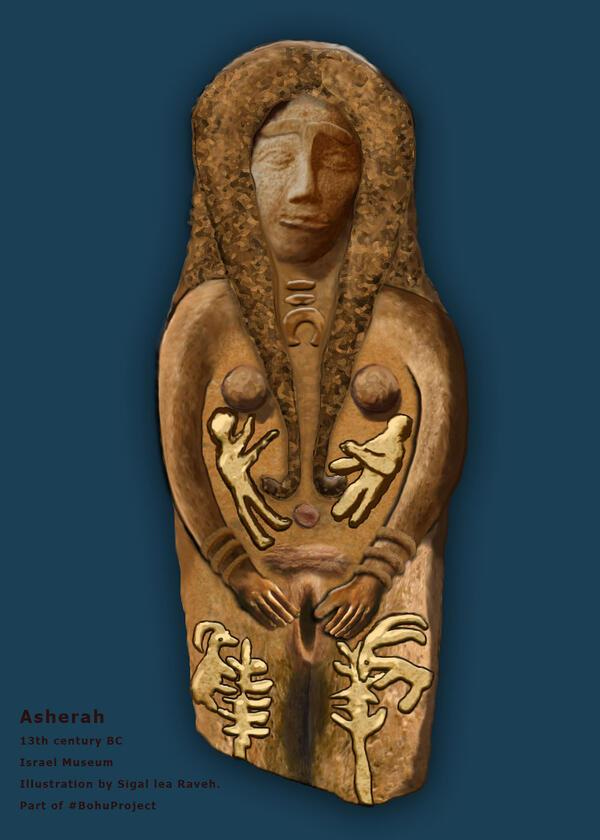
The high priestess of Asherah was known as none other than the Khnt.
Now for an examination of Biblical text. The most prevalent translation, the King James Version, was written by a literal woman-hater. Just a few years before overseeing this landmark adaptation of the Bible, King James I of England penned his own manuscript in 1597 – Daemonologie. He and his book would incite some of the fiercest witch trials in the world. Between 2500-4000 people were killed in Scotland alone, the vast majority of which were women. Much like the German Malleus Maleficarum written 100 years prior, King James’ obsession/terror of all things witch and woman led him to write a book devoted to the hunting down and killing of the feminine.
The King James Translation is arguably the most influential book in the world. And James ensured his view of the might of men would prevail. Two small examples include 1 Timothy 2:11, where in the original text Paul advises women to learn in quietness, while James decided they should be rendered silent. Romans 16:1 introduces Phoebe as a deacon originally, but the KJV demoted her to a servant.
The suppression of women is suppression of cunctipotency.
So while the word Cunt was originally linked to power of the feminine, use of the term now is almost always used as an attempt to strip someone of their power. Words in and of themselves are neutral. It is society that gives them their tolerability or offensiveness. In a Christian-centered world where anything hinting at paganism is deemed unacceptable, words stemming from the venerability of the feminine are to be shunned.
The founding fathers of the modern Church well understood the power of sexuality. Paganism accepted and even lauded sexuality as a natural phenomenon occurring in everything from plants to animals (including humans). But the quelling of that has been occurring for the last 2000 years. To be clear, patriarchal Christianity should never be confused with the early Church known as The Way, which centered Jesus’ often decidedly feminine ideology as the foundation they stood for. No, the Christian machine we know today is what spread after Constantine, and at its root it operates with a complete dread of the Cunt.
Cunctipotency. Womb wisdom. This feminine strength is diametrically opposed to patriarchal power, which is power as domination. Cunt wisdom is empowerment and the making/channeling of energy.
The earliest human traditions understood this energy as Nature. It is why we use the term ‘Mother Earth’ to describe our world and its generative qualities. Representations of the vulva were not pornographic, they were the analogy of life. The mother goddess was known as the ‘womb and tomb’ of all living beings.
This brings me to one of my favorite mysteries carved in stone – the Sheela-Na-Gig. They stop you in your tracks when you spot one, and can be found in the most unlikely places throughout the UK and Ireland. What’s fascinating is how similar they are to the above image of Asherah, with their hands very clearly holding the Vulva open. Ironically, Sheela-Na-Gigs are mostly found in churches, mixed in among gargoyles, iconography, and carvings of plant life. There has never been an agreement on what they symbolize, but theories have ranged from sin, to childbirth, to protection against evil.
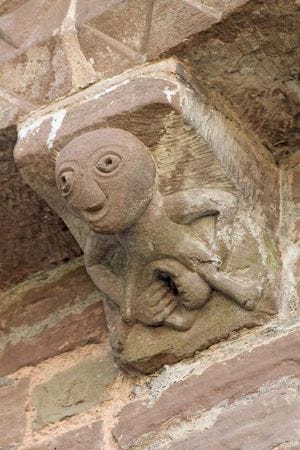
Barbara Freitag examined the connection between the Sheela-Na-Gig and churches, determining that the carvings were from a much older, folk tradition. She concluded that they most likely correlated to assistance in childbirth. But the most recent scholarly examination comes from Joanne McMahon and Jack Roberts. The title of their 2023 work, The Sheela-na-Gigs of Ireland and Britain: The Divine Hag of the Christian Celts, encapsulates the message. This being is a reminder of a pagan past that refuses to disappear.
I leave you with this. While the OED translates Sheela-Na-Gig to mean ‘Julia of the Breasts,’ Sheelas are hardly ever depicted as having breasts at all. Instead they have a prominent and enlarged – you guessed it – Cunt.
A Folktale for our Time

Keep me helpless
with electricity, machinery, windows shut
tight against the cold North Wind.
Elements cannot reach
air conditioning, your weatherproof boots
and hearths burning books.

Keep me ignorant
with tales of mouthless women—
no paint no powder no name.
Gossip about my absence,
my presence, my sex that is nature
when snowdrops appear.
These are nursery tales.

In truth I take the shape I wish—
you cannot tell my youth
or haggard age because you reduce
my existence down
to a cunt, a birthing hole
for future voracious eaters.
Instead I’ll open it wide,
inviting in the poor, the refugees
you keep away with sticks.

I take what you loathe and multiply it,
certain my whoring
is my salvation,
a green mantle I drape across
the land I shaped, taking back the birthright
of my bastard children.
Reclaiming my sovereignty like the spring
slowly overpowers a harsh winter.
I could give you twenty names to call me;
what does it matter when I am all one?

©Amanda Coleman White
Thanks to frooting bodies 🍄 for reminding me of this conversation with my advisor.
Just a note. You alluded to the early followers of Jesus, before Constantine. There are a couple of excellent gospels, one being the Gospel of Mary Magdalene, in which Mary Magdalene had a close, intimate relationship with Jesus. This is evidenced by writings throughout this gospel, but most notably in the fact that Mary Magdalene was the first person to see the resurrected Christ, mistaking him for a gardener, at first. She was called in both this gospel and the canonical gospels as the apostle to the apostles because of this. She also rallied the other (male) apostles after Jesus’ death, who were afraid for their lives.
All of this has been systematically suppressed by mainstream Christianity from the get go, and now especially by the fundamentalist groups much in vogue by the Hegseth crusaders (who are actively courting what they believe will bring Christ to earth, namely Armageddon). This being a well accepted but egregiously and dangerously false reading of scripture.
…the first written language was “cuneiform” which pictograph represented the female genitalia. In the beginning was God. In the beginning was the Word. And the first words were carved into rocks and animal skins with “cuneiform” the ubiquitous pie shaped triangle…
Word ⭐️